The mending project culminated in an exhibition of my classes work. It ran for three weeks from 28th May - 15th June 2014. I was really happy with the final display of my work. I decided to keep the composition looking random so that the negative space could be balanced out. It was challenging to affix the ceramic to the wall and I lost a few plates as a result the day before opening. However I managed to make new ones just in time. I'd like to thank Watt Space for accommodating us and my class mates for helping to make this possible. It is such a pleasure to have the opportunity to exhibit my work whilst I am overseas.
Showing posts with label Embroidery. Show all posts
Saturday, 31 May 2014
Wednesday, 9 April 2014
Mending Ceramics
From my charity shop hunt I have found a variety of old plates that I am going to mend. I began by smashing them all and glueing most of the pieces back together.
I realised a simpler way of fixing the thread to the ceramic surface. I have taped down the warp threads with Sellotape, and it worked wonderfully. I was then free to weave in the weft threads over the surface and tape to secure. AS only one side of the ceramic will be on display, this has made it a quick and tidy way of presenting my work. I then started to darn over the holes in red thread. I wanted to use the same thread throughout the project so that there was a theme running through. I like the symbolism of red and i feel it reflects upon this project through anger and the concept of breaking the plates.
I like the arrangement that these photographs show. I can imagine them being up on a wall in this formation. I was most pleased with the two plates that broke with holes in the middle as this replicates my paper samples the best. I want to continue before the exhibition with this until I get 10 samples that I am really happy with.
Thursday, 3 April 2014
Problem Solving
Hallelujah! I have discovered a solution!
Although i am very adverse to using glue, I have come to the conclusion that for this to truly work, I need to use glue to hold the pieces in place. I have found an old antique plate that I broke apart. I then glued all but a few of the pieces back together along with some bias binding and experimented with darning over the whole using red thread. I was thrilled with the outcome as this will ensure the work can hang in a gallery space and also have a darned area where the missing piece would have been.
Next I will visit a local charity shop and source lots of crockery for me to 'mend'. I want to use old fashioned plates as this reflects upon the traditional craft methods I am using as well as a society when we would normally fix things as oppose to buying new.
Although i am very adverse to using glue, I have come to the conclusion that for this to truly work, I need to use glue to hold the pieces in place. I have found an old antique plate that I broke apart. I then glued all but a few of the pieces back together along with some bias binding and experimented with darning over the whole using red thread. I was thrilled with the outcome as this will ensure the work can hang in a gallery space and also have a darned area where the missing piece would have been.
Next I will visit a local charity shop and source lots of crockery for me to 'mend'. I want to use old fashioned plates as this reflects upon the traditional craft methods I am using as well as a society when we would normally fix things as oppose to buying new.
Thursday, 20 March 2014
Paper Plates
Whilst I ponder over how I am going to attach my ceramic plates together, I bought some paper plates as a prototype to experiment darning and stitching with.
I really like these results, but I am conscious that this is created with paper. I feel like what will make this project is the embroidery process of contrasting the hard surface of ceramic with the soft surface of thread. I am pleased with these experiments and I feel this has helped me visualise how I want the final outcome to look.
I would like to produce about 8-10 final samples that I will hang on a wall as if they were china plates hanging on a wall. Using light a shadow will become very important as the surface will become distorted. This layout on the blog is helping me to visualise how I want to final outcome to look.
Monday, 17 March 2014
Finding things to Mend
I now know where my project is going; I want to explore mending everyday objects and how this can be achieved through darning.
I want my work to make a statement about 'mending' and how everyday objects don't necessarily need to be thrown away.
I started my search in a skip. Here I found a students ceramic works that had been discarded. I jumped at this opportunity to re create one mans waste.
I want my work to make a statement about 'mending' and how everyday objects don't necessarily need to be thrown away.
I started my search in a skip. Here I found a students ceramic works that had been discarded. I jumped at this opportunity to re create one mans waste.
I took a hammer to these two pieces to break them apart. I then used a drill press to put holes into them in order for me to sew them back together. I came into some difficulties here as drilling through ceramics is not an easy task. Once the piece has been glazed, the glaze creates a glass like surface which is difficult to drill through.
The brown piece wasn't thick enough and every time I tried to drill through it, it shattered into more pieces. However the blue piece, took to the drill quite well and I was able to sew it back together.
I am pleased with the outcome as it has given the piece a new direction and has recused it from the skip. I want to experiment further with using recognisable objects so that when mended, the context of the project is more clear through the objects them selves.
I also began to experiment with stitches, thread and mending further found objects.
Next I want to play around with using household ceramics such as plates and bowls as I feel like this is what the project needs to be clear about the message I want to convey.
Wednesday, 12 March 2014
Darning
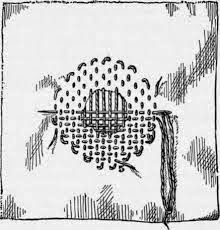
Darning is a traditional 'mending' technique. It is a stitch that is generally used to fix holes, often in socks and jeans.
I find the techniques fascinating and feel like I can use this to exaggerate the 'mending process' as well as embellish objects.
Here I have attempted to darn over holes and on different fabrics to understand the technique. Weaving through the threads can be a laborious process but i feel that the end result is perfect for this project. It shows how traditional methods of embroidery can be used to mend and exaggerate the mending process.
Friday, 24 January 2014
Final Samples
I found these bright match sticks by chance when buying some other art materials. The colour caught my eye as it fits in perfectly with my colour pallet. I experimented with what I could do with them and enjoyed the movement it gave to the rubber matting. I could fill in the negative space and create a new surface at the same time. This works well in terms of Leutton Postle too, the colour and shape could be an embellishment to an exsisting product, or like before take on a new form as accessories. It has a tribal feel to it also. I became really excited by this and produced many samples. Here are a few photographs of me exploring what could be done with this shape.
Using the same black matting I also experimented with producing larger gathered samples. I loosely threaded through some bright string and then gathered the whole thing very tightly. This has created a very tactile surface that could be used as a textile fabric for fashion or accessories purposes.
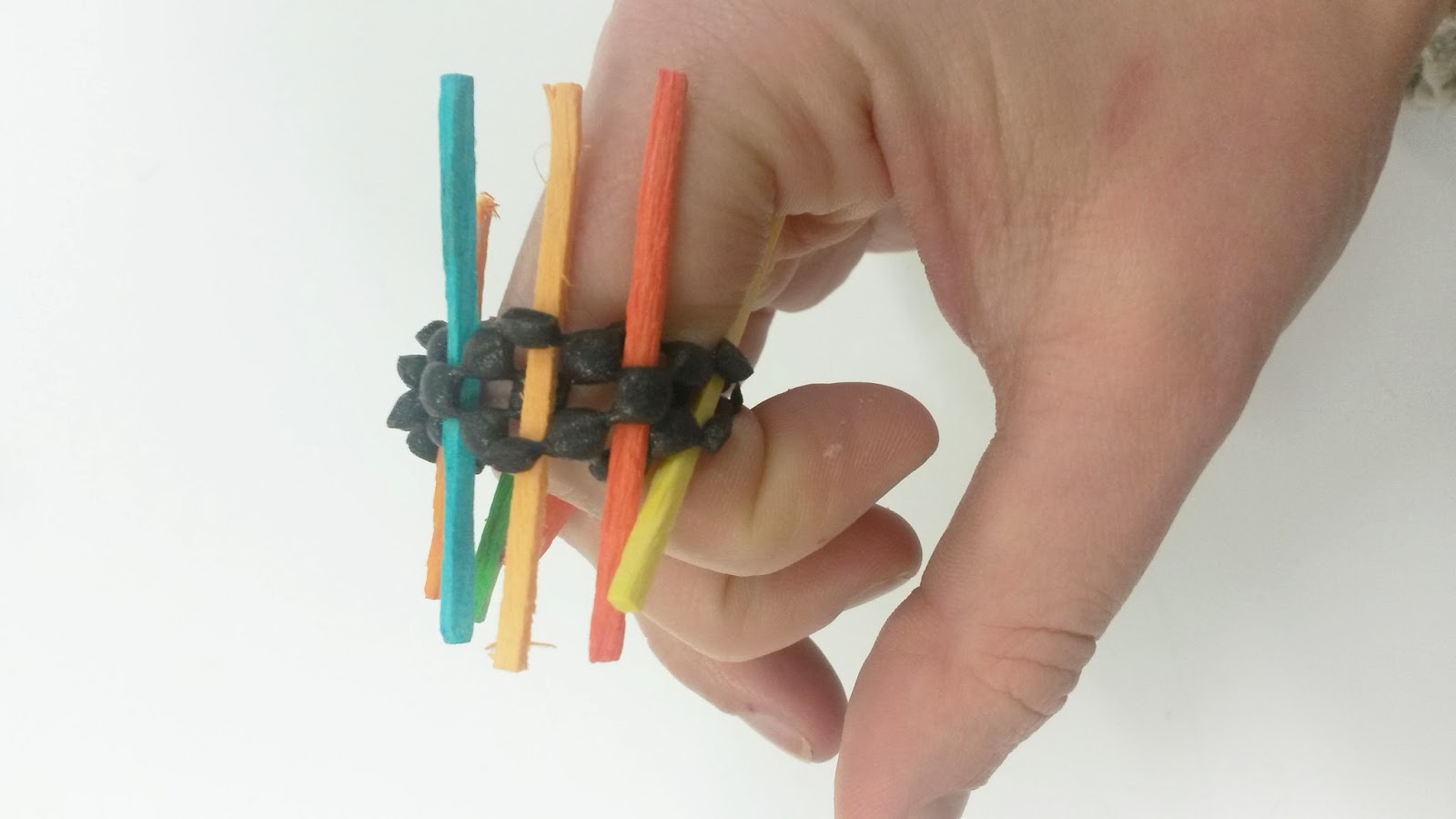
On reflection, I wish I had used this black colour early on as it is quite harsh and a surprise. I think the black helps it look more 'tribal' therefore matching Leutton Postle's most recent line.
Monday, 20 January 2014
Development Samples
I have begun to think further about how I will be incorporating colour within my samples and more specifically how to apply colour. In this sample I applied painted water colour on and then gathered the piece together. Whilst on the right, I applied colour after it was gathered and used it to print. I preferred the results when colour was applied before gathering as the tones feel more muted.
Tuesday, 7 January 2014
Rubber Matting
Time has been a major factor affecting me in this project. I only have 4 weeks to complete the project - half what I have been used to. The brief also mentions that the final product needs to be quick and simple to produce. I want to begin playing with materials as that is how I learn most efficiently. Trial and error helps me to make informed choices about my samples.
I want to use the structures of Geodesic Dome and ideas about geometry and places of worship as starting points. I found some scraps of rubber matting whilst rummaging through an old box of materials in my house. The shape of it initially caught my eye as the square forms directly reflect upon my research.
I started to play around with the scraps that I had found and began to pair them up with other found materials to begin the experimentation process.
I want to use the structures of Geodesic Dome and ideas about geometry and places of worship as starting points. I found some scraps of rubber matting whilst rummaging through an old box of materials in my house. The shape of it initially caught my eye as the square forms directly reflect upon my research.
I started to play around with the scraps that I had found and began to pair them up with other found materials to begin the experimentation process.
I began by bunching material together and photographing different angles. I want to explore 3D as well as 2D. I then started to build first using safety pins and explore the properties of the rubber matting.
I am very interested in surface. This materials gives me lots of options to explore as it is a versatile material. Negative space is important to consider when using this surface.
Next I want to develop a colour pallet as this is necessary in relating the project back to the brief. Using Leutton Postle's colours as a theme I will be able to create samples that will slot into their collections and answer the brief.
Subscribe to:
Posts (Atom)


.jpg)